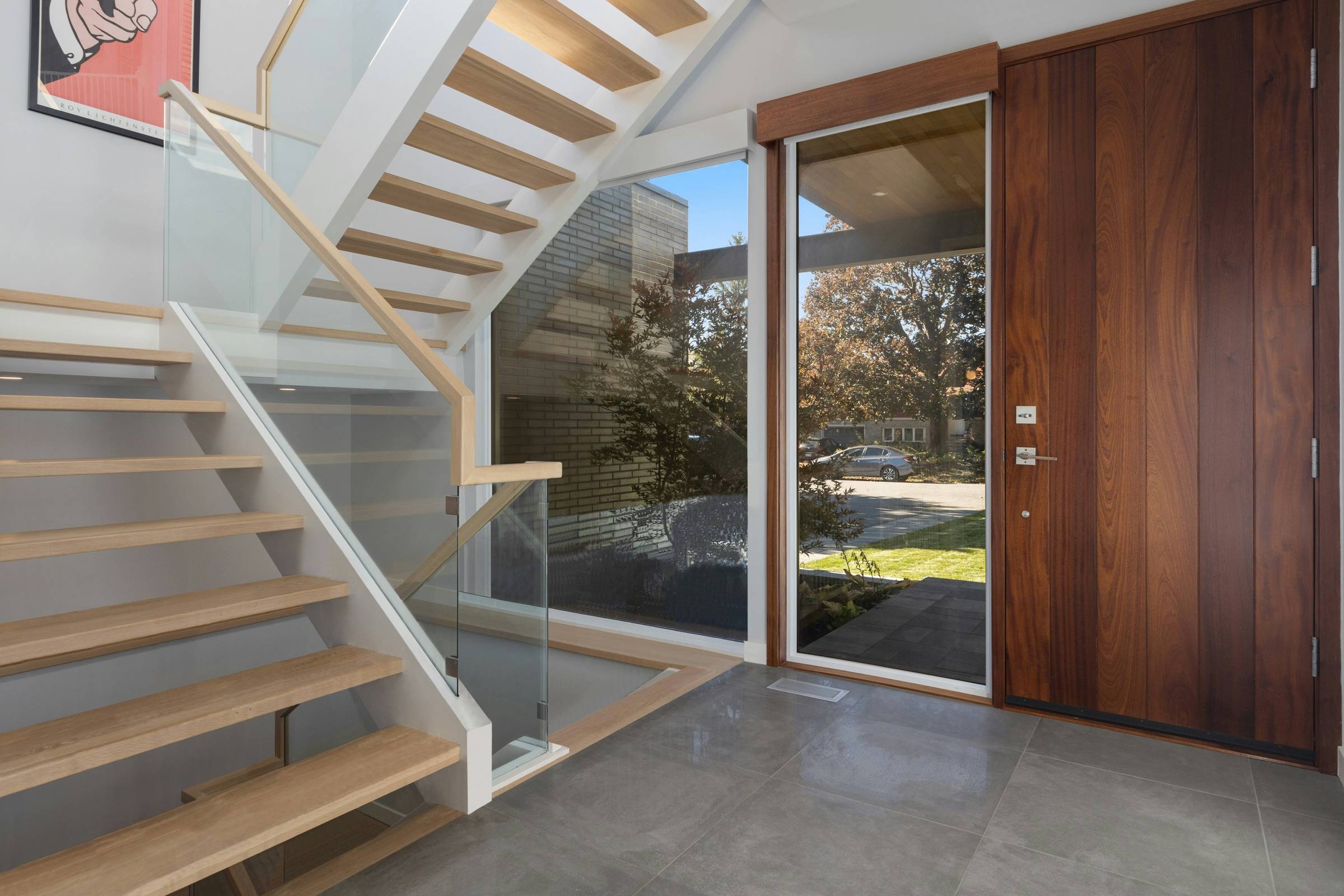
The published range
Complete floating stair and railing
Approximately $15,000–$100,000
per stair, manufactured package
Published manufacturer examples (product and materials, excluding shipping, tax, and installation) vary widely with system type, layout, landings, tread material, width, railing, finish, glass, lighting, and customization. Installation, shipping, taxes, opening work, structural preparation, and permits are generally additional. Highly customized or multi-flight stairs can exceed the published range.
Sources: Viewrail, Keuka Studios
Two manufacturers publish useful anchors. Viewrail states that most of its floating stair projects land between $15,000 and $77,000, and its FLIGHT pricing page (dated August 2026) excludes shipping, tax, and installation. Keuka Studios describes a range of roughly $15,000 to $100,000, often $20,000–$30,000 per flight, with installation excluded from its examples. Highly customized or multi-flight stairs can exceed these published ranges.
These are product-package figures from individual manufacturers, not national installed averages, and not every manufacturer offers every system described below.
Straight versus L-shaped, U-shaped, and turning layouts
A straight, single-flight stair tends toward the lower end of the range. Each turn adds a landing platform, more structural connections, guard corners, and engineering. In the planner, a landing platform is a planning allowance of $2,500–$7,000 before installation, and turned layouts apply a structure multiplier. Turns are sometimes unavoidable: they fit shorter footprints and can solve headroom conflicts with the floor above.
Mono-stringer versus dual-stringer, and cantilever concepts
A mono-stringer uses one central steel spine; the treads appear to float on either side. A dual-stringer stair uses two stringers under the treads and generally costs less to fabricate and install. Cantilevered concepts anchor treads into a wall and need a wall designed for that load — often the most structurally demanding option. The planner’s straight-flight structure anchors are $10,000–$21,000 for a mono-stringer and $8,000–$16,500 for a dual-stringer, before treads and railing. See types of metal stairs.
Stair width, tread thickness and species, and landings
Width scales both treads and structure. Treads are priced individually, so a stair with 15 treads multiplies any upgrade 15 times. Planning ranges per tread at 36 in width: basic hardwood $200–$380, standard premium hardwood such as white oak $260–$460, and premium species $500–$950; thick “floating” treads add roughly 25–45%. Manufacturers such as Viewrail publish species and thickness options; check which combinations your chosen system supports.
Cable, rod, glass, or picket railing
Railing on a floating stair is often both a stair guard and an upper-level overlook guard. Cable and rod keep the stair visually open at moderate cost; glass is the most transparent and usually the most expensive; pickets are familiar and economical. A separate graspable handrail is often still required. See the cable and glass railing guides.
LED lighting and interior or exterior use
Tread lighting adds fixtures per tread plus a licensed electrician for wiring, drivers, and controls; plan conduit before drywall. Most floating stairs are interior; exterior versions need exterior-rated treads, coatings, and drainage, and are less commonly offered as packages.
Freight, installation, and structural preparation
- Freight: crated freight to the curb is typical; Keuka Studios estimates about $1,500 to under $5,000.
- Installation: heavy spines and precise anchorage make installation a significant line item; the planner prices it separately by system and access.
- Structural preparation: mono-stringer stairs need solid anchorage at the top and bottom; retrofits may need new framing, steel, or concrete work by your builder.
Engineering, code, and opening verification
Floating stairs commonly need engineering. Opening size, headroom, landings, tread dimensions, and guard and handrail details must be confirmed against the locally adopted code. For context, the 2021 IRC model provisions include a minimum headroom of 6 ft 8 in (80 in) minimum, measured vertically from the sloped plane of the tread nosings (2021 IRC R311.7.2; 2024 IRC R318.7.2 — model code; verify locally) and a maximum riser of 7¾ in maximum; greatest riser may not exceed the smallest by more than ⅜ in within a flight (2021 IRC R311.7.5.1; 2024 IRC R318.7.5.1 — model code; verify locally). Read the code guide before relying on any dimension.
Multiple flights and realistic exclusions
Multiple flights multiply structure, treads, guards, and installation. Expect a manufacturer’s package to exclude some or all of: freight, tax, installation, opening and framing work, blocking, permits, electrical work, finish repair, and stamped engineering. The scope comparison table lists the questions to ask.
Sources
- Viewrail FLIGHT floating stair pricing
- Viewrail floating stair systems overview
- Viewrail stair tread options
- Keuka Studios guide to custom floating stair cost
- 2021 International Residential Code, Chapter 3 (Building Planning)